















Ear Seeds and Auricular Acupuncture: Do They Actually Work?
You've seen them on Pinterest and TikTok: tiny gold dots pressed onto someone's ear, captioned something like "5 minutes a day for calm." Maybe you've wondered if ear seeds are a real tool for a nervous system that won't switch off, or just another wellness trend dressed up in acupuncture language.
Here's the honest version. Ear seeds and auricular acupuncture are real practices with a real history in Traditional Chinese Medicine, and there is some clinical research behind the broader idea of stimulating points on the outer ear. But the research on ear seeds specifically is still thin, and a lot of what's floating around online overstates what a few small studies actually show. If your nervous system has been running hot for months (racing thoughts before bed, a jaw that won't unclench, a baseline hum of "on edge" that you can't quite name) you deserve a straight answer about whether this is worth your time, not a Pinterest caption.
So let's get into it: what ear seeds and auricular acupuncture actually are, what the evidence does and doesn't show, how to use ear seeds safely if you want to try them, and where they fit (and don't fit) alongside the rest of your nervous-system toolkit.

What Are Ear Seeds?
Short answer: Ear seeds are tiny seeds or beads taped to specific points on your outer ear, based on auricular acupuncture maps, to apply gentle pressure.
Ear seeds are small, round seeds (traditionally from the vaccaria plant, though metal or ceramic beads are used too) attached to the skin of the outer ear with a tiny piece of medical tape. They're placed on specific points that correspond to an auricular acupuncture map, a diagram that assigns different parts of the ear to different areas of the body and nervous system, based on Traditional Chinese Medicine (TCM) theory.[1]
The idea is that pressing on these points, either by tapping the seed with a fingertip or just from the pressure of wearing it, stimulates a response somewhere else in the body. Ear seeds are meant to be a low-effort, needle-free way to keep applying that pressure over several days, instead of needing a practitioner in the room every time.
You can buy ear seed kits online and apply them yourself, or have an acupuncturist place them for you during or after a session. They usually stay in place for three to five days before you remove them and, if you want to continue, replace them.
What Is Auricular Acupuncture, and How Is It Different From Ear Seeds?
Short answer: Auricular acupuncture uses fine needles at ear points in a clinical setting, while ear seeds apply gentle pressure at home with no needles at all.
Auricular acupuncture is the needle-based version of the same underlying map. A trained practitioner inserts fine, sterile needles into specific points on the outer ear, usually for a set session length, sometimes alongside body acupuncture. One well known variation is the NADA protocol, a standardized five-point ear acupuncture approach originally developed to support people going through substance use recovery, and later studied for stress and anxiety more broadly.[2]
Ear seeds are the at-home, self-administered cousin of this practice. No needle ever breaks the skin. You're applying pressure, not puncturing tissue, which is a meaningfully different mechanism and, as you'll see below, comes with a meaningfully different (and thinner) evidence base.
This distinction matters because a lot of the research you'll see cited for "ear seeds work" was actually done on needled auricular acupuncture, not on seeds. That's not a small technicality. It's the difference between citing a study and citing a study about a different intervention entirely.
Does Auricular Acupuncture Actually Work for Anxiety and Stress?
Short answer: Some trials show moderate anxiety reduction, especially pre-procedure, but evidence quality is moderate at best and safety data is patchy.
This is where things get genuinely interesting, and genuinely limited at the same time.
A 2022 systematic review and meta-analysis published in Explore pooled 13 randomized controlled trials involving 1,366 people and looked specifically at auriculotherapy (ear point stimulation, including both needled acupuncture and pressure-based methods) for anxiety.[3] The finding: auriculotherapy showed a moderate reduction in anxiety compared with placebo, and a similar moderate effect compared with a waiting-list control. The strongest signal was for pre-operative anxiety (anxiety right before a medical procedure), which showed a bigger effect than general anxiety or exam-related anxiety in students.
That sounds promising until you read the fine print. The review authors rated most of the evidence as moderate certainty, not high certainty, and flagged real problems: studies used different anxiety scales, different treatment protocols, and inconsistent session lengths, which makes it hard to compare them directly. Only one trial compared auricular acupuncture against an actual anti-anxiety medication for generalized anxiety disorder. And ten of the thirteen trials didn't properly record or report side effects at all, which is a genuine gap when you're trying to judge whether something is safe, not just whether it "works."[3]
A separate, earlier systematic review protocol focused specifically on pre-operative anxiety and auricular acupuncture found a similar pattern: some positive results, small-to-moderate trials, and a call for more rigorous research before anyone draws firm conclusions.[4]
Your body is trying to tell you something when your heart rate spikes before a procedure or your thoughts won't slow down before bed, and it makes physiological sense that stimulating nerve-rich areas like the outer ear (which has a direct connection to the vagus nerve, a major regulator of your parasympathetic "rest and digest" response) could nudge your nervous system toward calmer territory.[5] But "makes physiological sense" and "is proven to work" are two different claims, and the research right now only supports the first one with real confidence.
So the fair summary is this: auricular acupuncture has some real, published evidence behind it for anxiety, particularly short-term or situational anxiety, with a moderate effect size and moderate-quality evidence. It is not a proven, stand-alone treatment for anxiety disorders, it hasn't been well compared against standard treatments, and the safety reporting in existing trials is weaker than it should be.
Is There Evidence for Ear Seeds Specifically?
Short answer: Barely any. Most research covers needled auricular acupuncture, and studies on ear seeds alone are small, few, and lower quality.
Here's the part a lot of ear seed marketing quietly skips over: the research on ear seeds specifically is still thin. Not "thin but promising in a big way." Thin.
Most of the trials cited above studied needled auricular acupuncture or auricular acupressure delivered by a trained practitioner in a controlled setting, not a self-applied seed left on your ear for three days while you go about your normal life. A few smaller studies have looked at seed-based auriculotherapy specifically (for example, research on auriculotherapy with needles or seeds among nursing professionals dealing with occupational stress), and some report a reduction in perceived stress.[6] But these tend to be small trials, sometimes without a proper sham or placebo comparison, which makes it hard to know how much of the effect is the seeds themselves versus expectation, relaxation from the ritual of applying them, or simply paying more attention to your stress levels for a few days.
A systematic review on auricular acupuncture for primary insomnia, published in BMC Complementary and Alternative Medicine, pooled 15 randomized controlled trials with 1,429 participants and found improvements in sleep duration, sleep efficiency, and sleep quality scores compared with sham treatment or medication.[7] That sounds like a strong result, and on the surface it is a genuinely interesting signal. But the authors themselves rated the overall quality of evidence as low using the GRADE system (a standard tool researchers use to rate how much confidence to place in a body of evidence), citing poor study design, small sample sizes without proper power calculations, and a real risk of publication bias. Their own conclusion was that current evidence "is not yet adequate to provide a strong support" for the practice, and that better designed trials are needed.[7]
None of this means ear seeds are useless. It means the honest, unsexy truth is that we don't have the kind of large, well controlled, seed-specific research that would let anyone say "ear seeds are clinically proven to reduce anxiety." What we have is a plausible mechanism, some encouraging small studies on the needled version of the practice, and a much smaller pile of lower-quality research on seeds themselves. That's a reasonable basis for "worth trying if you're curious and it's low-risk," not for "this will fix your anxiety."
Can Ear Seeds Help With Sleep?
Short answer: Auricular acupuncture has low-quality evidence for better sleep, but no strong reason exists to expect ear seeds alone to fix chronic insomnia.
If you're one of the many women in perimenopause, PMDD, or a stressful PCOS diagnosis spiral who lies awake at 2am with your brain running a highlight reel of every conversation you've ever had, you already know that sleep and nervous-system regulation are tangled together. Anxiety keeps you up, and being sleep-deprived makes you more anxious the next day. It's a loop, and it's exhausting.
The insomnia review mentioned above did find that auricular acupuncture, compared with sham treatment, was associated with roughly an extra hour of sleep and meaningfully better sleep efficiency and quality-of-sleep scores.[7] Compared against sleep medication, it performed comparably on effectiveness with far fewer reported side effects, which is genuinely notable given how many people are wary of relying on sleep medication long-term.
But again: low overall evidence quality, and that review was largely looking at needled acupuncture, not seeds worn for days at a time. If you're dealing with ongoing insomnia, ear seeds are reasonable to experiment with as one small piece of a broader wind-down routine (alongside consistent sleep and wake times, reducing screens before bed, and addressing any underlying hormonal drivers) not as a stand-alone fix you'd reach for instead of talking to your GP about persistent sleep problems.

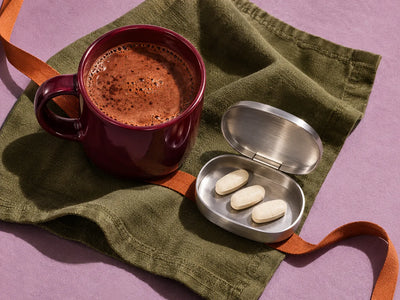
A magnesium hot chocolate blend with chamomile and lavender, containing magnesium and B6 which contribute to normal nervous system function and the reduction of tiredness and fatigue.
How Do You Use Ear Seeds?
Short answer: Clean the ear, place seeds on specific points using a chart or practitioner guidance, press gently a few times a day, and remove after 3 to 5 days.
If you decide you want to try ear seeds, here's the practical, no-fluff version:
If you want a ready-made kit rather than piecing one together yourself, AcuPips is a UK ear seed specialist founded by a practising acupuncturist. Their Ear Seeding Kit for Everyday Wellbeing (£32) comes with 80 seeds, 12 ear maps and tweezers, so you've got everything for the steps below in one box.
- Start with a licensed acupuncturist if you can. A practitioner trained in auricular acupuncture can map the points relevant to what you're targeting (stress, sleep, general nervous-system support) and place your first set correctly. This also gives you a chance to ask questions and flag any skin sensitivities before you're doing it solo.
- Clean and dry the outer ear first. Whether a practitioner applies them or you do it yourself with a kit, the skin needs to be clean and dry so the adhesive holds and irritation risk stays low.
- Use tweezers to place the seeds precisely. Most kits, AcuPips's included, come with the adhesive already applied to the seed. Press it firmly onto the mapped point so it stays put.
- Apply gentle pressure, not hard jabbing, three to five times a day. A light press with a fingertip for a few seconds is the general guidance. You're not trying to bruise yourself.
- Leave them in for three to five days, then remove. Wearing them longer than that raises your risk of skin irritation for no added benefit. If you want to continue, remove, let the skin rest, and reapply fresh seeds.
- Stop immediately if you notice pain, swelling, or a rash. That's your skin telling you the adhesive doesn't agree with it, not a sign to push through.
One practical note nobody tells you: waterproof seeds exist for showering, but even those can loosen over a few days. Don't panic if one falls off early. It's not a sign anything went wrong.

Are Ear Seeds Safe?
Short answer: Generally low-risk with no needle involved, but skin irritation, adhesive allergy, and seeds slipping into the ear canal are real, uncommon risks.
This is genuinely one of the lower-risk complementary practices out there, and it's worth saying plainly: you're not risking much by trying it, as long as you're sensible.
Because there's no needle breaking the skin, ear seeds sidestep the infection and bleeding risks that come with any needle-based procedure. But "low-risk" isn't the same as "zero-risk." The main things to know:
- Skin irritation and adhesive allergy. The most common issue by far. Some people's skin reacts to the medical tape or adhesive backing, especially with extended wear or sensitive skin. Redness, itching, or mild soreness where the seed sits is the usual sign.
- Seeds slipping into the ear canal. Uncommon, but it happens, particularly if seeds are placed too close to the canal opening or come loose. This can cause discomfort, temporary hearing changes, or need a clinician to remove it.
- Pregnancy caution. Certain auricular points are traditionally linked to labor stimulation in TCM theory. If you're pregnant, check with a healthcare professional and a practitioner experienced in pregnancy-safe auricular work before using ear seeds, rather than guessing at point placement yourself.
- Not a substitute for medical care. If you're managing a diagnosed anxiety disorder, chronic insomnia, or any condition alongside PCOS, endometriosis, PMDD, or perimenopause symptoms, ear seeds are a complementary add-on to discuss with your GP or specialist, not a replacement for the care plan you already have.
If you wear glasses, over-ear headphones, or sleep on your side and find the seeds physically annoying, that's a fair reason to skip them too. Comfort matters, and a nervous-system tool that stresses you out because it's uncomfortable isn't doing its job.

Ear seeds and supplements aren't the same category, and we won't pretend they are. But if you're building a broader approach to nervous-system support, magnesium and vitamin B6 both have an authorised role in normal nervous system function and normal psychological function, which is part of why they're in our Balance formula.
Should You Try Ear Seeds?
Short answer: If you're curious, they're low-risk and inexpensive to try as one small piece of a bigger nervous-system routine, not a stand-alone fix.
You're not imagining it if you've tried five different "calm down" tactics this month and none of them have fully worked. Nervous-system regulation isn't a single switch. It's a collection of small, boring, repeated inputs: sleep, movement, nutrition, breathwork, therapy, sometimes medication, and yes, sometimes complementary practices like this one.
Ear seeds are cheap, low-risk, and take almost no time to apply. If the idea appeals to you and you don't have a skin sensitivity concern or a reason to avoid them (like early pregnancy without practitioner guidance), there's little downside to trying a week or two and paying attention to how you actually feel, rather than how a Pinterest caption told you that you'd feel. Track it honestly. If it seems to help you feel a bit steadier, keep going. If it does nothing for you, that's useful information too, and it doesn't mean something is wrong with you. It just means this particular tool isn't your tool.
What ear seeds shouldn't be is the only thing in your toolkit, or a reason to delay seeing a GP about anxiety, insomnia, or hormonal symptoms that are genuinely disrupting your life. Complementary means alongside, not instead of.
Frequently Asked Questions
Do ear seeds actually do anything, or is it a placebo effect?
Honestly, we don't fully know for ear seeds specifically. Some small studies suggest a stress-reducing effect, but sample sizes are small and many lack a proper placebo comparison, so a real physiological effect and a placebo response can't yet be cleanly separated.
How long does it take for ear seeds to work?
There's no clinically established timeline for ear seeds specifically. People who use them often press the points a few times a day and reassess after a few days of wear, but this is based on common practice, not a proven protocol.
Can I put ear seeds on myself without seeing a practitioner?
You can buy self-application kits, but getting your first placement from a licensed acupuncturist is worth it, especially so you learn where the relevant points actually are and get a chance to flag any skin concerns first.
Are ear seeds the same as acupressure or reflexology?
They're related concepts (all use pressure on mapped points rather than needles) but auricular acupuncture and ear seeds specifically use the ear-based point map from Traditional Chinese Medicine, while general acupressure and foot reflexology use different maps on different parts of the body.
Can ear seeds help with PMDD or perimenopause anxiety specifically?
There's no research on ear seeds for PMDD or perimenopause specifically. The broader auricular acupuncture research on anxiety and stress may be relevant, but you should treat this as an unproven, complementary option, not a targeted treatment for a hormonal condition.
Do ear seeds hurt?
No. There's no needle involved, so at most you might feel a small amount of pressure or tenderness when you press the point, similar to pressing a bruise lightly.
How much do ear seeds cost?
Self-application kits are inexpensive, typically the cost of a coffee or two for a multi-use pack. A practitioner-applied session will cost more, similar to an acupuncture appointment.
Can I wear ear seeds every day, all the time?
It's generally recommended to remove them after three to five days and let the skin rest before reapplying, rather than wearing the same seeds continuously, to keep skin irritation risk low.
References
- Cleveland Clinic. "Thinking About Using Ear Seeds? What You Should Know." health.clevelandclinic.org/ear-seeds
- NADA Canada Institute. "NADA Protocol Research & Evidence." nadacanadainstitute.com/research
- Kwon, C.Y., et al. "Is auriculotherapy effective and safe for the treatment of anxiety disorders? A systematic review and meta-analysis." Explore, 2022. sciencedirect.com/science/article/pii/S1876382022000580
- "Auricular Acupuncture for Preoperative Anxiety, Protocol of Systematic Review and Meta-Analysis of Randomized Controlled Trials." Medicines, 2020. pubmed.ncbi.nlm.nih.gov/33256202
- Butt, M.F., et al. "The anatomical basis for transcutaneous auricular vagus nerve stimulation." Journal of Anatomy, 2020. onlinelibrary.wiley.com/doi/10.1111/joa.13122
- "The applicability of auriculotherapy with needles or seeds to reduce stress in nursing professionals." Revista Latino-Americana de Enfermagem, 2012. pubmed.ncbi.nlm.nih.gov/22441270
- Cao, H., et al. "Auricular acupuncture for primary insomnia, a systematic review and meta-analysis." BMC Complementary and Alternative Medicine, 2015. link.springer.com/10.1186/s12906-015-0606-7
Further Reading
This article is for general information only and does not replace advice from your GP or a qualified healthcare professional. Food supplements should not be used as a substitute for a varied and balanced diet. If you're pregnant, breastfeeding, taking medication or managing a diagnosed health condition, check with a healthcare professional before starting a new supplement.
Discover your perfect product in under a minute!
References