


















Myo-Inositol vs D-Chiro-Inositol: What's the Difference?
By Leila Martyn, Founder of MyOva
Myo-inositol and D-chiro-inositol are two forms of the same small molecule. Myo-inositol is the form your body and your food contain most of. D-chiro-inositol is made from myo-inositol by an enzyme, and it shows up in far smaller amounts. Both have been tested in women with PMOS (PCOS), the condition formerly called polycystic ovary syndrome [1]. The short answer to "which is better?" is that nobody knows yet. The biggest review of the trials calls the evidence for inositol in PMOS limited and inconclusive, and it didn't find that any one form or ratio wins [2].
You're not imagining it: the labels make this confusing on purpose. 40:1, "dual inositol", "the ratio your body uses". Below is what each form is, what the trials tested, where the 40:1 ratio comes from, and how to read a label. We sell supplements that contain inositol, so we'll tell you up front which of ours contain which form.
New to MyOva? Join our mailing list for straight-talking hormone guides in your inbox. If you're new to inositol, start with Myo-Inositol Explained, then read Inositol for PMOS (PCOS): What the Research Shows. To compare doses across our range, see our myo-inositol supplements page.
In this guide
- What is the difference between myo-inositol and D-chiro-inositol?
- What do myo-inositol and D-chiro-inositol do in the body?
- What does the research say about D-chiro-inositol?
- What does the research say about myo-inositol?
- Is the 40:1 ratio better than myo-inositol alone?
- Which is better for PMOS (PCOS): myo or D-chiro?
- Can you take too much D-chiro-inositol?
- How do you read an inositol supplement label?
- When should you talk to your GP?
- FAQ
What is the difference between myo-inositol and D-chiro-inositol?
In short: Same molecule, different shape. Myo-inositol is the common form in food and the body. D-chiro-inositol is made from it in much smaller amounts.
Inositols are a family of closely related molecules. They all have the same atoms, but one or more of those atoms points a different way, a bit like left and right hands. Two members of the family get all the attention in hormone health: myo-inositol and D-chiro-inositol.
Myo-inositol is the one you eat. It occurs naturally in many everyday foods, which researchers have measured and catalogued [3]. Your body also makes it. D-chiro-inositol is made from myo-inositol inside your cells by an enzyme called an epimerase, which converts one form into the other [4]. Both take part in the chain of signals that follows when insulin binds to a cell, which is why researchers became interested in them for PMOS in the first place [5].
Here's the side-by-side version:
| Myo-inositol | D-chiro-inositol | |
|---|---|---|
| Where it comes from | Food, plus what your body makes | Made from myo-inositol by an enzyme [4] |
| Amounts in the body | The larger share | Much smaller amounts |
| Doses used in PMOS trials | Mostly 1 to 4 g a day [2] | 600 mg to 1.2 g a day when used alone [2] |
| Best-known trial | No single landmark trial; mostly compared with metformin [2] | 1999 trial in 44 women [6] |
| What the 2024 review said | Possible benefit for some metabolic measures | Possible benefit for some metabolic measures and for ovulation |
| Overall verdict | Limited and inconclusive for both [2]. The 2023 international guideline calls inositol in any form experimental [7]. | |
What do myo-inositol and D-chiro-inositol do in the body?
In short: Both help carry insulin's message inside cells. In PMOS, lab studies suggest the balance between them may be off, but the details are unsettled.
When insulin lands on a cell, it sets off a relay of chemical messages inside it. Inositol-containing molecules are part of that relay. The theory goes like this: if insulin's message isn't getting through properly, the body makes more insulin to compensate. In PMOS, high insulin is thought to push the ovaries to make more androgens such as testosterone, which links the metabolic and reproductive sides of the condition [5]. If you want the bigger picture, our guide to PMOS (PCOS) and insulin resistance breaks it down.
Two lab findings get quoted a lot, so here's what they actually showed.
- Women with PMOS may lose more D-chiro-inositol in their urine. A US study compared 23 women with PMOS and 26 without. Urinary clearance of D-chiro-inositol was almost six times higher in the PMOS group, and higher clearance went with lower insulin sensitivity [8]. That's an observation, not a treatment trial. It doesn't show that taking D-chiro-inositol corrects anything.
- The ovary may be the odd one out. In theca cells (hormone-making cells in the ovary) taken from women with PMOS, researchers found a lower ratio of myo-inositol to chiro-inositol and higher activity of the enzyme that converts one into the other. They noted this goes in the opposite direction to what's seen in insulin-resistant tissue [4]. In other words, the ovary may already be converting plenty of myo-inositol into D-chiro-inositol.
Put those together and you get the argument you'll see online: the rest of the body may be short of D-chiro-inositol, while the ovary may have more than enough. It's an interesting hypothesis, and it's part of why some researchers favour myo-inositol for ovarian outcomes. But these are small lab and observational studies. They tell us where to look. They don't tell you what to take.
Hormonal literacy isn't complicated, it's just rarely taught. The honest version here is that the biology is plausible and the clinical proof is thin.
What does the research say about D-chiro-inositol?
In short: Two small US trials found lower insulin and some hormone changes. The 2024 review saw possible ovulation benefit but called the evidence limited.
The most quoted inositol study of all is about D-chiro-inositol, not myo-inositol. In 1999, Nestler and colleagues gave 1,200 mg of D-chiro-inositol a day, or a placebo, to 44 women with PMOS and obesity for six to eight weeks. Ovulation occurred in 19 of 22 women taking D-chiro-inositol against 6 of 22 on placebo [6]. That's a striking result, and it's why D-chiro-inositol got so much attention.
The same research group then ran a trial in lean women. Twenty women with PMOS took 600 mg of D-chiro-inositol or a placebo once a day for six to eight weeks. In the D-chiro group, the insulin response to a glucose drink fell and free testosterone dropped by 73%, with no significant change on placebo. Six of 10 women ovulated on D-chiro-inositol against 2 of 10 on placebo, but that difference wasn't statistically significant [9].
Here's the catch. These were short trials with 20 and 44 participants. Small trials can produce big effects that shrink or vanish when larger studies are done. When the 2024 review for the international guideline pooled the evidence, it said there were potential benefits from D-chiro-inositol for ovulation and benefits from myo-inositol or D-chiro-inositol for some metabolic measures. It still concluded that the evidence for inositol in PMOS is limited and inconclusive [2].
So D-chiro-inositol isn't a dud. It's a promising lead that has never had the large, independent trial it needs.
What does the research say about myo-inositol?
In short: More trials, but most compare it with metformin, not placebo. Possible metabolic benefits, no proven fertility benefit, no benefit in pregnancy.
Myo-inositol has been studied more often, but mostly in a way that makes the results hard to read. In the 2024 review, trials of myo-inositol on its own used 1 to 4 g a day for six weeks to six months, and most compared it with metformin, another inositol product or no treatment, rather than a placebo [2]. Without a placebo group, it's hard to separate the inositol from expectation and time.
What the review did report:
- Metabolic measures: evidence suggests benefits from myo-inositol or D-chiro-inositol for some of them, mostly on low certainty evidence [2].
- Compared with metformin: reproductive outcomes were likely similar, metformin may improve hirsutism and waist-hip ratio more, and myo-inositol likely causes fewer digestive side effects [2].
- Other outcomes: inositol may have no effect [2].
On fertility, a Cochrane review of inositol for women with PMOS who were struggling to conceive found the evidence too uncertain to draw conclusions [10]. The draft NICE guideline goes further and says inositol is not effective for fertility problems. It also says there's uncertainty about its benefit for metabolic health [11]. NICE expects to publish the final version in December 2026, so this wording could change.
On pregnancy, the MYPP trial gave 464 pregnant women with PMOS either 2 g of myo-inositol with folic acid or folic acid alone, twice a day, until delivery. The combined rate of gestational diabetes, pre-eclampsia or preterm birth was 25.0% on myo-inositol and 26.8% on placebo. The authors concluded myo-inositol shouldn't be recommended as dietary advice for pregnant women with PMOS [12].


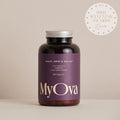
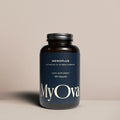
Four tablets a day give 4,000mg myo-inositol (no D-chiro-inositol), with vitamin B6, which contributes to the regulation of hormonal activity, folate, and chromium, which contributes to the maintenance of normal blood glucose levels. No health claim is authorised for myo-inositol. Speak to your GP first if you take medication, including diabetes medicines, or are pregnant or breastfeeding.
Is the 40:1 ratio better than myo-inositol alone?
In short: Not proven. Trials tested several ratios and D-chiro-inositol alone, and the 2024 review didn't find that any ratio works best.
You'll see 40:1 on a lot of labels. It's the ratio of myo-inositol to D-chiro-inositol in a combination used in several trials: 550 mg of myo-inositol with 13.8 mg of D-chiro-inositol, usually with folic acid, twice a day. Marketing often says it matches the ratio found in your blood. But trials also tested other ratios, including 3.6 to 1, as well as D-chiro-inositol on its own [2]. The review didn't conclude that one ratio beats another [2].
There's another reason to read ratio claims with care. Much of the early inositol research came from a small number of research groups, and some widely quoted inositol authors have since had a run of retractions on other work [13]. That doesn't make every inositol study wrong. It does mean independent replication matters more than usual, and for ratios it hasn't happened at scale. We've left those older papers out of this guide.
The research on this is actually pretty clear on one point: a ratio printed on a label is a formulation choice, not proof that the product does more.
Which is better for PMOS (PCOS): myo or D-chiro?
In short: Nobody can say. No large trial has compared them head to head, and guidelines call inositol in any form experimental, not proven.
This is what I wish someone had told me: there's no winner, because the race hasn't been run properly. The trials that exist are small, short, use different doses and ratios, and measure different things. The 2023 international PCOS guideline, which drew on that 2024 review, says inositol in any form should be considered an experimental therapy [7]. Experimental doesn't mean dangerous. It means unproven.
That leaves you with a personal call, ideally made with your GP. Here's a fair way to think about it:
- Start with what you're hoping for. If it's fertility, NICE's draft guidance says inositol isn't effective for fertility problems, so talk to your GP about tested options first [11]. If it's metabolic health, the evidence suggests possible benefit for some measures, at low certainty [2].
- Know what you're actually buying. Myo-inositol only, D-chiro only, or a blend. Check the amount of each per daily serving, not per capsule.
- Don't pay extra for a ratio. No ratio has been shown to beat another [2].
- Make it a fair test. Trials ran for six weeks to six months [2]. Track your cycle, skin and energy, and set a review date in advance.
- Keep taking prescribed medicines unless your doctor tells you otherwise.
Your diagnosis is a starting point, not a verdict. Testing tells you more than any supplement label, so if you suspect insulin resistance, ask your GP about the right blood tests. Our guide to blood tests to ask for with PMOS (PCOS) gives you the words to use.
Take our free product quiz
Answer a few questions about your symptoms and goals and we'll point you to the MyOva products that fit. Finish the quiz and your 20% off code is revealed at the end.
Can you take too much D-chiro-inositol?
In short: Trial side effects were mostly mild, but long-term and high-dose data is thin. Stick to the label and ask your GP if pregnant or on medicines.
In the 2024 review, digestive side effects were reported in six trials and other side effects in two, and the authors described them as typically mild and self-limited [2]. In the MYPP pregnancy trial, any possible side effect occurred in 6.9% of women on myo-inositol and 9.1% on placebo [12].
You'll also see claims online that too much D-chiro-inositol harms egg quality. The idea links back to the lab finding that ovarian cells in PMOS already convert a lot of myo-inositol into D-chiro-inositol [4]. It's a reasonable question to ask, but we couldn't find good-quality human trials that settle it either way, so we're not going to tell you it's proven. What we can say is that D-chiro-inositol trials used 600 mg to 1.2 g a day for weeks, not years [2], so nobody has solid long-term data on regular high doses.
Practical rules:
- Follow the serving on the label and don't stack several inositol products.
- Tell your GP or pharmacist what you're taking, especially if you take metformin or other medicines for blood sugar.
- If you're pregnant, breastfeeding or trying to conceive, check with your GP or midwife before starting. The NHS advises checking before taking any supplement in pregnancy [14].
How do you read an inositol supplement label?
In short: Find the amount of each form per daily serving, check for extra nutrients like B6, and add up totals if you take more than one product.
Labels are where most of the confusion happens. Run through these checks:
- Which form? "Inositol" on its own usually means myo-inositol. D-chiro-inositol is listed separately if it's there.
- How much per daily serving? Some products list amounts per capsule or per scoop, so multiply up.
- What's the ratio, if any? Divide myo-inositol by D-chiro-inositol. A 2,000 mg to 50 mg blend, for example, works out at 40 to 1.
- What else is in it? Extra nutrients such as vitamin B6 add up across products. Food Standards Scotland advises no more than 10 mg of vitamin B6 a day from supplements unless a medical professional advises it [15].
- What's the wording? In Great Britain, only authorised health claims can be made for nutrients, and there are none for myo-inositol or D-chiro-inositol [16]. If a label promises to balance your hormones or regulate your cycle with inositol, be sceptical.
Here's how our own range breaks down, per daily serving, so you can see it in one place:
| MyOva product | Myo-inositol | D-chiro-inositol |
|---|---|---|
| Myoplus (4 tablets) | 4,000 mg | None |
| Menoplus (4 capsules) | 2,000 mg | 50 mg |
| Preconception, Pregnancy, Balance, Metabolism, Hair Skin & Nails (4 capsules) | 2,000 mg | None |
| Women's Multivitamin (2 capsules) | 350 mg | None |
So most of our formulas use myo-inositol only. Menoplus, our perimenopause and menopause formula, is the one exception: it contains 50 mg of D-chiro-inositol alongside 2,000 mg of myo-inositol, which happens to be a 40 to 1 ratio. We're telling you that so you can make your own call, not because the ratio has been shown to do more. Myoplus costs £32 for 120 tablets, which is 30 days at four a day, or about £1.07 a day.

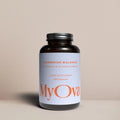
2,000mg myo-inositol and 50mg D-chiro-inositol with botanicals, vitamin B6 and B12, which contribute to the reduction of tiredness and fatigue and normal psychological function. Contains red clover and sage: speak to your GP first if you take HRT or have had a hormone-sensitive cancer. Not suitable in pregnancy or breastfeeding. Provides 10mg B6, so don't combine with other B6 supplements.
If you're in midlife with PMOS, our guide to PMOS (PCOS) and perimenopause covers what changes and what doesn't.
When should you talk to your GP?
In short: Before starting if you're pregnant, trying to conceive or on medicines, and whenever periods are irregular or missing or symptoms get worse.
Your body is trying to tell you something when cycles go missing, skin flares or energy crashes. A supplement shouldn't be the first or only response. Book a GP appointment if:
- Your periods are irregular, infrequent or have stopped, and you're not pregnant [1].
- You've been trying to conceive for a year, or sooner if you're 36 or over or have a known cause such as PMOS [17].
- You take metformin, insulin or other medicines and want to add inositol.
- You're pregnant or breastfeeding and already taking inositol. Don't stop or start anything on the strength of an article; decide with your midwife or GP [14].
- Low mood or anxiety is weighing on you. That's worth raising in its own right.
Take notes: your cycle dates, symptoms and anything you're already taking, with amounts. If you've felt brushed off before, our guide to advocating for yourself at the GP has scripts that help.

Frequently asked questions
What is the difference between myo-inositol and D-chiro-inositol?
They're two forms of the same molecule with one part pointing a different way. Myo-inositol is the common form in food and the body. D-chiro-inositol is made from it by an enzyme, in much smaller amounts [4].
Is myo-inositol or D-chiro-inositol better for PMOS (PCOS)?
No one can say yet. The 2024 review found possible benefits for both on some metabolic measures and for D-chiro-inositol on ovulation, but called the evidence limited and inconclusive [2].
Do I need a 40:1 myo-inositol and D-chiro-inositol blend?
There's no good evidence you do. Trials tested several ratios and D-chiro-inositol alone, and the review didn't find that any ratio works best [2].
Can I take myo-inositol and D-chiro-inositol together?
Some trials used combinations, and side effects reported in trials were mostly mild [2]. Follow the label, don't stack products, and check with your GP first if you're pregnant, trying to conceive or on medicines.
Does inositol help you get pregnant?
It isn't proven. The draft NICE guideline says inositol is not effective for fertility problems, and a Cochrane review found the evidence too uncertain [11, 10].
The bottom line
Myo-inositol and D-chiro-inositol are two shapes of the same molecule. The lab science on how they're handled in PMOS is interesting, and a couple of small D-chiro-inositol trials looked promising. But the best review of the evidence calls it limited and inconclusive, guidelines call inositol experimental, and there's no proof that any form or ratio is better than another. If you choose to try inositol, pick a product that tells you exactly how much of each form you're getting, give it a fair, tracked trial, and keep your GP in the loop. It's not a magic fix, and we'd rather tell you that than sell you one.
Compare our myo-inositol formulas
See the myo-inositol and D-chiro-inositol amount in every MyOva formula, side by side, before you choose.
Compare formulas →Free UK shipping on orders of £50 and over.
Want more like this?
Get evidence-led hormone guides from Leila, without the hype. No spam, unsubscribe any time.
Join our mailing list →Related reading
- Myo-Inositol Explained: Dose, Side Effects and the Evidence
- Inositol for PMOS (PCOS): What the Research Shows
- PMOS (PCOS) and Insulin Resistance: Understanding the Link
- The Role of Myo-Inositol in Fertility Treatments: What the Research Actually Shows
- Myo-Inositol in Pregnancy With PMOS (PCOS): The Evidence
- Menopause Supplements: 9 Ingredients, Honestly Rated
This article is for general information only and isn't medical advice. MyOva products are food supplements, not medicines, and aren't intended to diagnose, treat, cure or prevent any disease. No health claim is authorised for myo-inositol or D-chiro-inositol. Guidance details are accurate to the sources cited at the time of writing and may change when NICE publishes its final PMOS guideline. Speak to your GP or pharmacist before taking supplements if you're pregnant, breastfeeding, trying to conceive, taking medication or managing a diagnosed condition.
References
- NHS. Polyendocrine metabolic ovarian syndrome (PMOS), formerly polycystic ovary syndrome (PCOS). Last reviewed 30 June 2026.
- Fitz V, Graca S, Mahalingaiah S, et al. Inositol for polycystic ovary syndrome: a systematic review and meta-analysis to inform the 2023 update of the international evidence-based PCOS guidelines. Journal of Clinical Endocrinology and Metabolism. 2024;109(6):1630-1655.
- Clements RS Jr, Darnell B. Myo-inositol content of common foods: development of a high-myo-inositol diet. American Journal of Clinical Nutrition. 1980;33(9):1954-1967.
- Heimark D, McAllister J, Larner J. Decreased myo-inositol to chiro-inositol (M/C) ratios and increased M/C epimerase activity in PCOS theca cells demonstrate increased insulin sensitivity compared to controls. Endocrine Journal. 2014;61(2):111-117.
- Diamanti-Kandarakis E, Dunaif A. Insulin resistance and the polycystic ovary syndrome revisited: an update on mechanisms and implications. Endocrine Reviews. 2012;33(6):981-1030.
- Nestler JE, Jakubowicz DJ, Reamer P, Gunn RD, Allan G. Ovulatory and metabolic effects of D-chiro-inositol in the polycystic ovary syndrome. New England Journal of Medicine. 1999;340(17):1314-1320.
- Teede HJ, Tay CT, Laven JJE, et al. Recommendations from the 2023 international evidence-based guideline for the assessment and management of polycystic ovary syndrome. Human Reproduction. 2023;38(9):1655-1679.
- Baillargeon JP, Diamanti-Kandarakis E, Ostlund RE Jr, Apridonidze T, Iuorno MJ, Nestler JE. Altered D-chiro-inositol urinary clearance in women with polycystic ovary syndrome. Diabetes Care. 2006;29(2):300-305.
- Iuorno MJ, Jakubowicz DJ, Baillargeon JP, Dillon P, Gunn RD, Allan G, Nestler JE. Effects of D-chiro-inositol in lean women with the polycystic ovary syndrome. Endocrine Practice. 2002;8(6):417-423.
- Showell MG, Mackenzie-Proctor R, Jordan V, Hodgson R, Farquhar C. Inositol for subfertile women with polycystic ovary syndrome. Cochrane Database of Systematic Reviews. 2018;CD012378.
- National Institute for Health and Care Excellence. Polycystic ovary syndrome (PMOS): draft guideline for consultation (GID-NG10436), July 2026. Final publication expected December 2026.
- van der Wel AWT, Frank CMC, Bout-Rebel R, et al. Myo-inositol supplementation to prevent pregnancy complications in polycystic ovary syndrome: a randomized clinical trial. JAMA. 2025;334(13):1151-1159.
- Retraction Watch. Gynecologists in Italy collect more retractions and an expression of concern. 17 February 2026.
- NHS. Medicines in pregnancy.
- Food Standards Scotland. Vitamin B6 (pyridoxine).
- Department of Health and Social Care. Great Britain nutrition and health claims (NHC) register.
- National Institute for Health and Care Excellence. Fertility problems: assessment and treatment (NG257). Published 31 March 2026.

About the author
Leila Martyn is the founder of MyOva. She built MyOva for women who've been told "it's just your hormones" and sent away without answers. Her goal is for every woman to feel informed about her own cycle and confident asking for the care she needs.
Discover your perfect product in under a minute!
References